
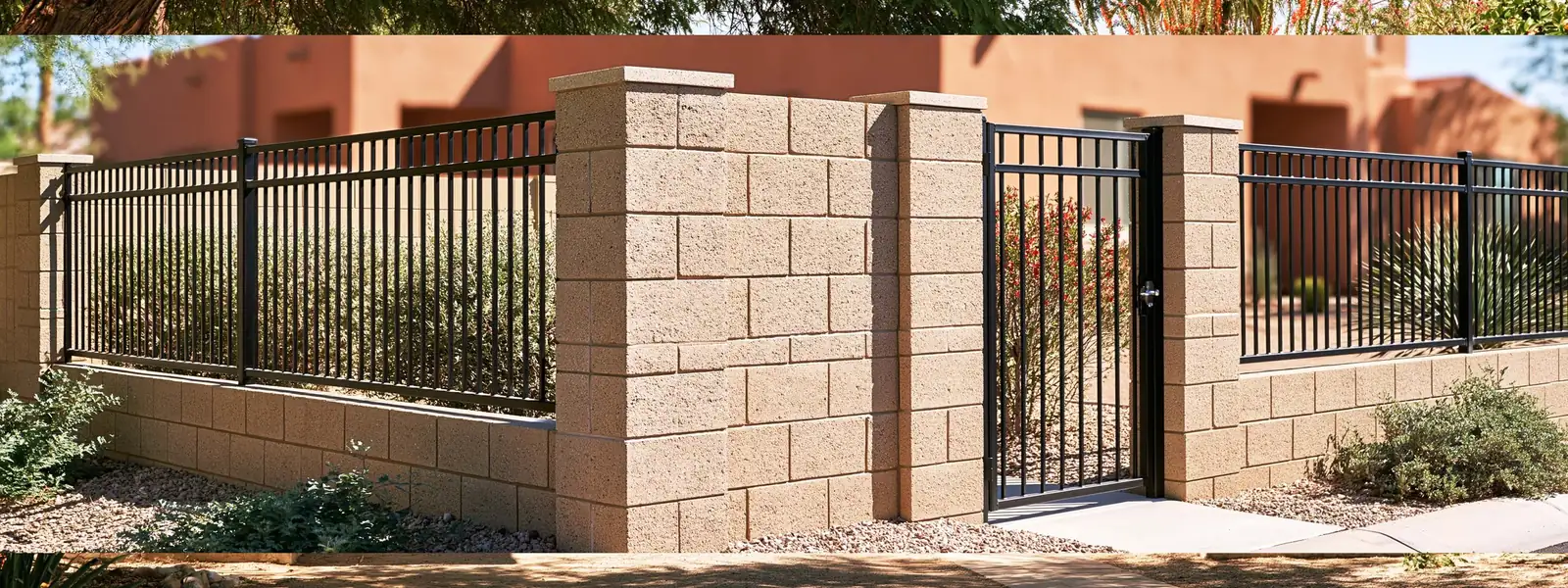
Fence and Block Wall Questions in Tempe, AZ

Answered Plainly

Costs, block walls, gates, materials in the heat, and the rules. A short answer to each, then the page that goes deeper.

Call (480) 470-8551 Get Your Free Estimate

The Questions That Come Up First

These are the fence questions Tempe, AZ callers put to us before anything else, answered the way we would answer them standing in your side yard. They come from what Tempe Fence Company gets called out for most often, so none of it is a pitch for a product line. It is what the failure usually turns out to be.

One thing shapes most of it: your wall is as old as your neighborhood. The block went up with the houses, and it is failing on schedule. Each answer links to the page carrying the full version. Call (480) 470-8551 if yours is not here.
Costs and estimates

Price is the first question on almost every call, and the honest answer always has the same shape: no number before someone walks the run. What follows is what actually moves a figure up or down, which is more useful to you than an average would be. Read it against a quote you already have and you will usually find what a cheaper bid left out.

How much does fence installation cost?

No honest number exists before someone walks it. What moves it: linear feet, height, gate count, material grade, how hard the soil digs, grade change along the run, and tearing out whatever is there now. Permits add if you go tall. Start at wood fence or vinyl fence.

How much does fence repair cost?

Count posts, not panels. Two failed posts behind eight ugly boards is a small job; posts wobbling the length of the run is a different conversation. Access for equipment and gate hardware move it too. Details on fence repair.

What is the average cost of a wrought iron fence?

An average would mislead you. Height, pattern, gate count and footing conditions swing iron pricing further than any other material. Ask instead what a given quote includes: coating, footing depth, gate hardware. See wrought iron fencing.

Why do two quotes for the same fence come back so far apart?

Usually something invisible from the street: post depth, footing size, post reinforcement, material grade. On vinyl especially, two products look identical on the shelf and behave nothing alike in July. Ask each bidder to name the product line. More on vinyl fence.

Block walls

Most of the walls in this metro are concrete block, most of them went up with the houses, and most of them are reaching the same point at the same time. Almost every question in this group comes back to one thing, which is what the wall is standing on. Read the ground before you read the crack, because the block is usually the symptom rather than the cause.

What is a CMU block wall?

Concrete masonry unit. Hollow gray block, laid in courses on a poured footing, joints filled with mortar, cells filled with steel and grout. It is the standard perimeter wall across this metro: no rot, no repainting, and fire separation some municipal codes call for. See block wall construction.

Why is my block wall leaning?

Look under it. Soil settled or heaved, the footing tilted, and the wall rode along. The block itself is usually intact. That is the tell. Any repair that touches only the courses and ignores what they sit on comes back. Full breakdown on block wall repair.

What is the white powder blooming on my block?

Efflorescence. Water moves through the wall, evaporates at the face, and leaves the dissolved salt behind. Scrubbing removes the evidence, not the water path, so it returns. Treat it as a map to where moisture is getting in. Covered on block wall repair.

Can a cracked block wall be repaired, or does it get rebuilt?

Depends entirely on the footing. Isolated stair-step cracking above a footing that has not moved gets repointed and patched. Footing failure, several leaning sections, or rebar rusting through the cells and the run comes down. Someone has to read it in person. See block wall repair.

Retaining walls are a different trade, and we do not take them on

A freestanding property wall carries only itself and whatever the wind pushes against it. A retaining wall holds back soil, which pushes sideways all day and harder after rain, so it needs engineering, drainage behind it, and reinforcement sized to that load. The two can look nearly identical from the front.

If your wall is holding ground back, hire an engineer and a retaining wall specialist. Freestanding property walls are what we do, and those are covered on block wall construction.

Gates

A gate is the only part of a boundary that moves, so it wears at a completely different rate from the fence it sits in. That is why the gate questions get their own group. Nearly every one of them resolves into a single question, which is whether the post has to come out of the ground. Everything cheap sits on one side of that line and everything expensive sits on the other.

How much does a gate cost to repair?

The dividing line is whether the post has to come out. Hardware swaps, latch adjustment and bracing a racked frame are short visits. Pulling and resetting a hinge post means digging, concrete and waiting on cure. That is the expensive version. Welding and self-closing hardware add. See gate repair.

Can wrought iron gates be repaired?

Most of the time. Cracked welds get re-welded, worn hinges get replaced, and a gate that no longer hangs square usually gets re-hung rather than rebuilt. The exception is a bottom rail rusted through. Once the frame has lost steel, you are building a new gate. See wrought iron fencing.

How can I fix my gate?

Find the cause before buying parts. Open it halfway and sight the hinge post against something you know is vertical. Plumb and solid means the problem is hardware or a racked frame, and a brace or heavier hinges often solve it. Moving or leaning means stop. That is a post job. See gate repair.

What are common fence gate problems?

Sagging and dragging, latches that no longer line up, hinge posts working loose, cracked welds and rust at the base of iron frames, wood gates going out of square as the timber dries. Nearly all of it traces to post movement or undersized hardware. See gate repair.

Why does my automatic gate stop partway?

The operator hit resistance and quit, or a safety device told it to. Gates bind where the track, hinge or hardware is worst, and openers are built to stop rather than force it. Release the operator and push by hand. If it fights you, the gate is the problem, not the motor. See automatic gate repair.

Materials and heat

Material choice here is decided by sun rather than by rain. Nothing rots the way it does in a wet climate, and almost everything degrades in ways a catalog page will not mention: coatings give up at the sprinkler line, vinyl chalks if the grade is wrong, and wood bleaches and cups long before it decays. These answers are really about which failure you are choosing.

What are the disadvantages of a wrought iron fence?

You see through it, so it gives no privacy and stops no wind. It rusts. Here that starts at the footing line, where the coating is thinnest and sprinklers hit it. And it costs more at install. What you get back is a fence microbursts do not flatten and that repairs panel by panel for decades. See wrought iron fencing.

What is a cheaper alternative to a wrought iron fence?

Chain link, if the job is containment and a defined boundary. It costs less per foot, goes up fast and repairs in sections. Wood and vinyl cost less than iron and add privacy, but both answer to the sun. Choose by the job, not the name. See chain link fence.

Does vinyl fencing survive a Tempe summer?

The good grade does. UV-stabilized vinyl has been tested to 117°F without sagging. Low-grade product looks identical on day one, then chalks, stiffens and bows. Grade is the whole story on a vinyl quote, so get the product line in writing. See vinyl fence.

Does wood rot in the desert?

Not from rain. Above grade it is sun damage: bleaching, checking, boards cupping. At grade it is collar rot, because caliche blocks drainage and the post hole holds water like a bucket. Depth, a gravel base and concrete crowned to shed water are what actually decide the lifespan. See wood fence.

Rules, permits and pool barriers

This group is the one place on the site where getting it wrong has consequences past a callback. Pool barriers are state law and apply everywhere in Arizona. Height limits and permits are set by your city, and your association can be stricter than the city is. Everything below is general information to orient you rather than a code determination, and the inspector is the one who decides.

What is the fence law in Arizona?

There are two layers. Pool barriers are state law under ARS 36-1681, and they apply anywhere in Arizona. Everything else is local: height limits, permits and corner-lot visibility are set by your city, and your HOA can be stricter than the city. This is general information, not a code determination. See pool fencing.

How tall can my fence be in Tempe, and when do I need a permit?

Tempe generally limits front-yard height to 4 feet, with 6 to 8 feet possible under a use permit with architectural features, and allows 8 feet in rear and side yards on single-family lots. A permit is required above 6 feet. Corner lots carry sight-triangle limits under Sec. 4-702(G). Verify with the City of Tempe. See block wall construction.

What does Arizona require around a pool?

Under ARS 36-1681 the barrier has to stand at least 5 feet high, or 4 feet where a house wall forms part of it. Gates must be self-closing and self-latching and open outward, away from the water, with the latch either at least 54 inches above the ground or on the pool side with no opening greater than half an inch within 24 inches of it. A fine can be waived if the barrier is brought into compliance within 45 days of the citation and the owner completes an approved pool safety course. Cities can be stricter, and the inspector decides. See pool fencing.

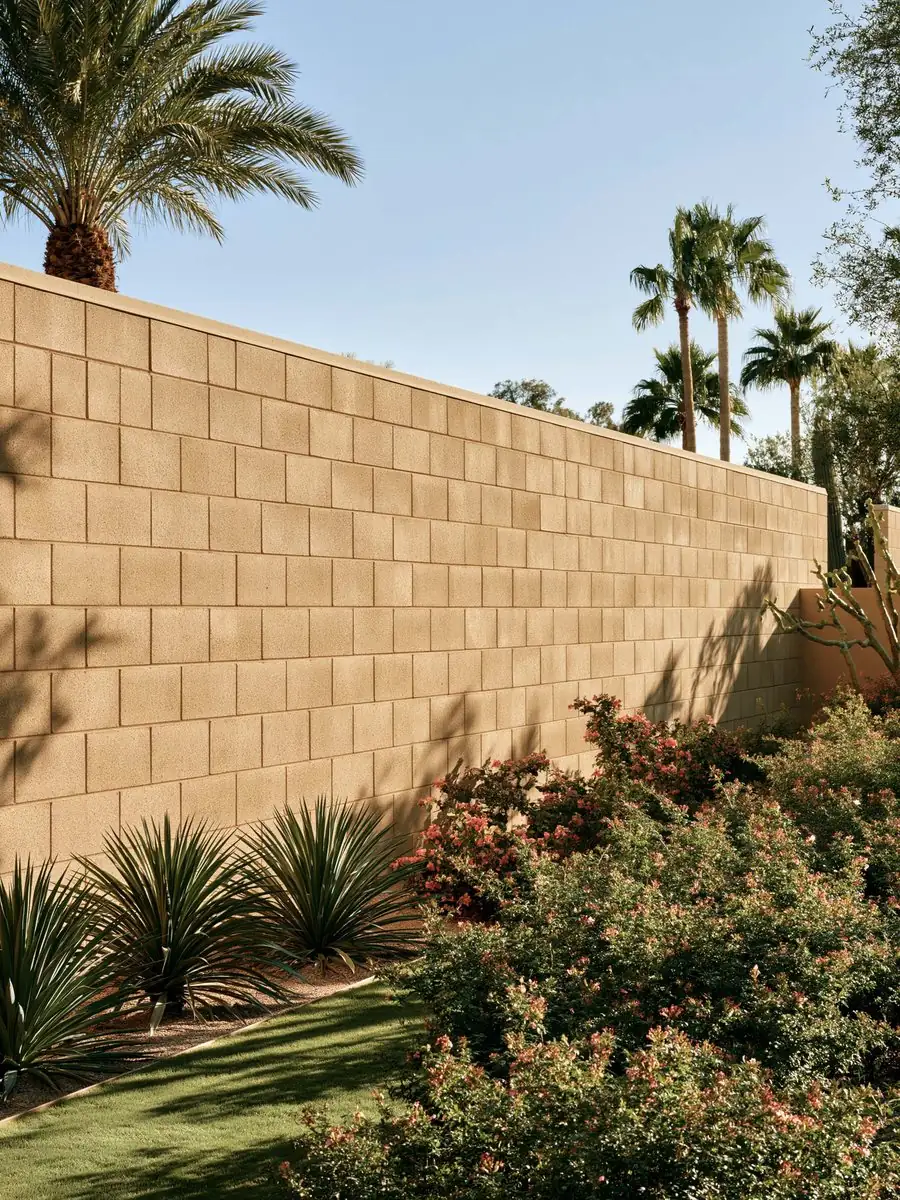
Finished tan block wall running along a desert-landscaped back yard in Tempe, AZ

Still Not Sure Which Answer Is Yours?

Most of these come down to something nobody can see from a photo, which is what the wall or the post is standing on. Someone comes out, looks at it, and gives you a firm price in writing. No cost, and no obligation to book the work. Call (480) 470-8551 or fill out the form.

Most answers start below the ground.

Call (480) 470-8551