

Gate Repair in Tempe, AZ

A gate that drags on the concrete, sticks halfway or needs a lift and a shove before it will latch. Most of them are a re-hang and new hardware rather than a new gate, and the fix usually starts with the post rather than the gate. Free estimates, with a firm price in writing.

Call (480) 470-8551 Get Your Free Estimate
Gate repair in Tempe, AZ, a black iron entry gate hanging square between two stucco pillars with a paver path leading up to it

The First Part of a Fence to Go, and the Easiest to Put Right

Every other part of your fence just stands there. The gate is the only part with moving parts, so it is the first thing on a property to start acting up. That is not a sign the fence was built badly. It is the gate doing the one job nothing else has to do.

Tempe Fence Company works on side gates, back gates and driveway gates across Tempe and the East Valley, in wood, in iron and in chain link. Wide ones, narrow ones, ones a car goes through and ones that only see a trash can.

Gate repair in Tempe comes down to one question, worth asking before anyone quotes you a new gate: has the gate changed, or has the post it hangs on moved? Most of the time the gate is still square and sound. The ground under one post has shifted, the gate now hangs out of line with its opening, and the rest follows.

Someone comes out, opens and closes it a few times, tells you which of the two you have, and gives you a price in writing. The visit is free, with no obligation.

Why a Gate Moves When the Rest of the Fence Does Not

A fence post holds up a panel that never goes anywhere. A gate post holds a weight that swings out away from it and comes back again, several times a day, for years. Every one of those swings is a small tug on the post, always in the same direction.

Add to that what the ground here does. Under a good deal of Tempe there is a hard layer a foot or two down that water does not pass through, so a post hole holds water instead of draining it. Rain and irrigation fill it, summer heat pulls it back out, and the post loses a fraction of its grip each time round. Wood softens where it meets the soil, and steel corrodes along the same line, out of sight.

The post is doing all the work

None of that has to move much to show at the other end of the gate. A post that tips a fraction toward the opening drops the far corner by a lot more, because the gate is long and the post is the short end of it. That is why a gate can look fine at the hinges and drag badly at the latch.

You can check it yourself. Open the gate halfway and look at the post it hangs on against something upright: a house corner, a downspout, the neighbor's block wall. If the top of the post leans toward the opening, the gate is not sagging. The post is moving, and no work on the gate will change that.

Why it sticks in the afternoon and swings free in the morning

Metal grows when it gets hot. An iron or chain link gate that fits its opening comfortably at seven in the morning is a touch larger by four in the afternoon in July. A gate that catches in the heat and swings clean first thing is not broken. It is telling you the opening has no spare room left, which usually means something has closed the gap since the gate went in.

Wood tells the same story a different way. Sun here dries wood out and bleaches it rather than rotting it, and as it dries the fixings loosen and the rectangle pulls out of square. A gate out of square catches on one corner before it catches anywhere else.

Signs Your Gate Wants a Look

The bottom of the gate scrapes the concrete, or has worn a curve into it
You lift the gate, or lean on it, to get the latch to catch
The gap down the latch side is tight at the bottom and open at the top
The post the gate hangs on leans toward the opening when the gate is open
The gate swings shut on its own, or will not stay where you leave it
It closes fine in the morning and sticks by the middle of the afternoon

Repair It, Re-Hang It, or Replace It?

The parts of a gate that fail are the cheapest parts of it. Hinges, a latch, the screws holding both on, a brace across the back. The expensive part is the gate itself, and on most gates we get called to, that is the one part with nothing much wrong with it.

That is why the first answer here is almost never a new gate. It is a re-hang: the post dealt with, the gate back in line with its opening, and hardware that suits its weight.

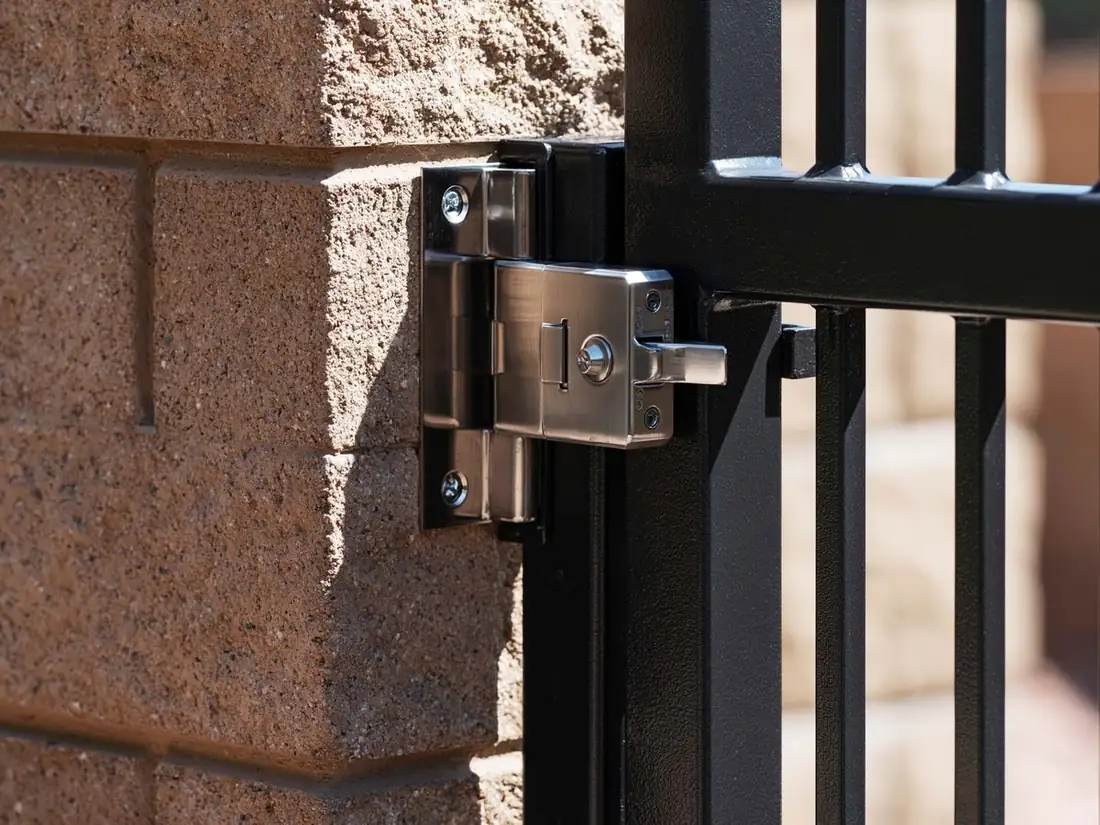
Close view of a clean gate hinge and latch on a black iron gate in Tempe, AZ, the hardware bright and properly aligned against the block pilaster

What a re-hang actually puts right

  • The post gets set straight and solid again, which is the part that decides whether any of the rest of it holds.
  • The hinges get reset or replaced with a size and a count that suit the weight of the gate, not whatever came in the box with it.
  • The gate gets squared up and braced across the back, so it keeps that shape instead of working out of it again.
  • The latch gets moved to meet the gate where it now sits, rather than the gate being lifted to the latch every time somebody closes it.

Moving the catch on its own is the tempting shortcut, and it works for a while. What it does not do is stop the post moving, so the gate carries on dropping and the catch runs out of adjustment. Worth doing properly once.

When a gate has genuinely reached the end

Sometimes it has. Rust eaten right through an iron frame in more than one place, wood rails gone soft the whole way through, or a frame so far out of shape that squaring it would open gaps everywhere else. Then a new gate is the honest answer, and it still gets hung on a post sorted out first. A new gate on an old leaning post starts dragging on the same schedule the last one did.

If the fence on either side has moved as well, that is fence repair, quoted together rather than as two visits. For a new iron gate or a matching panel, wrought iron fencing covers how those are made and finished. If your gate has a motor on it, start at automatic gate repair, because an opener that stalls is usually reporting on the gate rather than failing itself.

What Moves the Price on a Gate Repair

Gates look alike from the street and price very differently, because most of what decides the number is either underground or in the hardware. These are the things that move it, and they are what gets looked at on the visit.

The estimate you get back is a firm price in writing covering exactly what the work includes, so you can hold it up against anyone else's on equal terms.

What the visit looks at

  1. Whether the post has to come out, or the gate re-hangs on the one already there
  2. How wide and heavy the gate is, which decides the hinges it needs
  3. What it is made of, and whether it needs welding or a new rail
  4. Whether the gate has to close and latch on its own, as a pool gate does
  5. How much rust there is, and whether it sits on the surface or has gone through
  6. Whether the fence on either side has moved along with the gate

What Putting a Gate Right Involves

Setting the post so that it stays set

If the post is the problem, it comes out, and how the new one goes back in is the whole job. The hole wants to be deep enough for the height it holds up, roughly one third to one half of what stands above ground, which is deeper than most people expect for a gate.

Then the water needs somewhere to go. A layer of gravel underneath breaks up the bucket the hard ground would otherwise make, and the concrete gets finished so it stands proud of the soil and slopes away, instead of sitting in a dish that collects every sprinkler cycle. That detail is most of the difference between a post that holds for years and one loose again after two monsoons.

Concrete also has to be left alone before a gate goes back on it. That can turn the job into two short visits rather than one, and if that is the case for yours it is in the written estimate rather than sprung on you on the day.

Gates that have to close and latch on their own

A gate around a pool is not just a gate. Arizona asks pool gates to close and latch on their own, to open away from the pool and to carry the latch high up out of a child's reach, and city rules can be stricter. This is general information rather than a code determination, and the inspector decides.

What matters for a repair is that self-closing hardware is far less forgiving than a plain latch. It only works if the gate hangs true and swings free, so a pool gate that has started needing a nudge has stopped doing its job. Pool fencing covers the rest of the enclosure.

Gate Repair Questions, Answered Plainly

How much does a gate cost to repair?

It depends almost entirely on whether the post has to come out. A gate that can be re-hung on the post it already has, with new hinges and the latch moved to suit, is a short visit and one of the least expensive jobs we do. Resetting a post means digging, concrete and time for it to take, and that is the biggest swing in the number. After that it is the weight of the gate, what it is made of, whether welding is involved, and whether it has to close and latch on its own.

Can wrought iron gates be repaired?

Nearly always, yes. Iron is the easiest of the three to bring back, because a section can be cut out and a new one welded in without touching the rest of the gate, and the finish carries across so the repair does not announce itself. Rust on an iron gate usually starts at the bottom, where the coating is thinnest and the sprinklers reach it, so a frame can look rough along the bottom while everything above it is sound. The question is whether the rust sits on the surface or has eaten through.

How can I fix my gate myself?

Work out what is wrong before you buy any parts, because most of the hardware people buy for this does not fix what is actually happening. Open the gate halfway and look at the post it hangs on against something upright nearby. If the post is straight and firm when you push it, you are looking at hinges or a gate gone out of square, and heavier hinges or a brace often sorts it. If the post leans or moves under your hand, stop there. New hardware on a moving post ends up where the old hardware was.

What are the common fence gate problems here?

Four of them cover almost everything. A gate that drags on the ground, a latch that will not catch without a lift, a gap down the latch side gone wedge shaped, and a gate that sticks in the afternoon heat and behaves in the morning. Underneath all four is usually the same cause: the post has moved a little and the gate is no longer square to its opening. The rest are wear items: hinges worn loose, screws backing out of dry wood, rust along the bottom of an iron frame. None of the four means a new gate.

My gate drags on the concrete. Does that mean I need a new one?

Usually not. A dragging gate is a re-hang far more often than a replacement. What you are seeing is the bottom corner furthest from the hinges sitting lower than it used to, and there are only three reasons for that: the post has tipped, the hinges have worn or worked loose, or the gate has pulled out of square. All three are fixable in place, and the gate goes back to clearing the concrete. Worth looking at sooner rather than later, because a dragging gate grinds away its own bottom rail.

My gate has an opener on it. Is that the same job?

Start on the automatic gate repair page for that one, though the two jobs overlap more than people expect. An opener senses how hard the gate is to move, and when it gets heavier at one point in its travel the opener stops, backs off or throws a fault rather than forcing it. That reads like a broken opener and usually is not. It is a gate gone out of line. Fixing the gate is what fixes the opener. A new opener without that just buys a stronger motor to fail in the same place.

See all fence and block wall questions →

Related Work in Tempe

Automatic Gate Repair

The same gate with a motor on it. Openers, keypads and driveway gates that stall.

See Automatic Gate Repair →

Fence Repair

When the post that moved took the fence on either side with it, and the gate is the loudest part.

See Fence Repair →

Wrought Iron Fencing

New iron gates and matching panels, and rust along the bottom rail dealt with.

See Wrought Iron Fencing →

Pool Fencing

Enclosures and gates that close and latch on their own, with no help from anyone.

See Pool Fencing →

Gates in Scottsdale

Iron and driveway gates on larger lots, where the gate is part of the view.

Fencing in Scottsdale →

Repairs in Guadalupe

Short runs and single gates on tight lots, done in one trip.

Fence Repair in Guadalupe →
Homeowner easing open a black iron side gate in a block wall at a Tempe, AZ home, the gate swinging clean on its hinges

Get Your Free Estimate

Tell us what the gate is doing. Dragging, sticking, not latching, or hanging at an angle. Photos help, though they are not necessary. Someone comes out, looks at the gate and the post it hangs on, and gives you a firm price in writing. No cost, no obligation. Call (480) 470-8551 or fill out the form.

A gate that drags is usually a hinge.

Call (480) 470-8551