
Here, the Paperwork Is Part of the Job
Tempe Fence Company works across Ahwatukee on walls, view fencing and gates that have to match something already standing. What a fence company Ahwatukee homeowners hire needs to understand is that the physical work is only half of it. The other half is describing that work precisely enough that it can be approved before it starts.
Communities here tend to have a settled look. Materials, heights, colors and finishes were chosen once, and everything built since reads as one piece because of it. Where that look is written down, changing a wall or a fence generally means getting a yes first.
We do not decide what your community requires and we do not interpret it for you. What we can do is write it up so it answers the questions an approval asks, so nothing gets built twice.
Bring the requirements to the estimate
If your community has written standards, have them out when we walk the property. It changes the estimate in a useful way. Permitted materials, heights, colors and cap details get priced in at the start instead of arriving later as a change to work already underway.
It also changes what we recommend. There is usually more than one sound way to fix a wall or replace a run, and knowing which options are already acceptable narrows it down before you have to think about it.
What gets written down, and when
What you get names the specifics rather than gesturing at them: material, height, color, finish, cap detail, the exact length being worked on, and where new work meets existing work. That is the level of detail an approval tends to ask for, so it can go in as it is.
The order that works is plain. Get it in writing, take it through whoever approves it in your community, then schedule the work. Doing it the other way around is how a finished repair ends up getting redone at somebody's expense.
If your requirements are unclear, or you are not sure whether what you want is allowed, that is a question for your community rather than for us. We will build to whatever answer comes back.
A Repair That Matches, and One That Draws the Eye
The test of a repair here is not whether it is sound. It is whether anyone can tell where it is from the sidewalk. A perfectly solid patch that reads as newer than the wall around it is the outcome that generates a letter, and the one a neighbor notices first.
Block is the hard case. Color and texture have both moved since most of these walls went up, so matching is a real exercise, and it comes down to four things.
- Choose the closest unit available now, knowing current block will not be an exact match for block laid decades ago.
- Blend the new work across a longer stretch rather than stopping it at a hard vertical line.
- Tool the joints the same way they were tooled originally.
- Carry the original cap detail through the repair.
If your wall is painted or coated, say so early, because it makes the whole problem easier. The finish carries across the repair and the match comes out effectively complete. Separating what can be repaired in place from what has to come out is covered on block wall repair.
Iron is matched by finishing the run, not the panel
View fencing has the same problem in a different form. A single panel refinished on its own sits next to panels that have been in the sun for years, and fresh coating against weathered coating reads as two fences even when the color code is identical.
So the honest answer on iron is often the whole run rather than the damaged part of it, in the color your community already uses. What that involves is on wrought iron fencing. The same logic applies to a wood or vinyl run where only a few boards or panels are bad, which is the judgment call behind fence repair.
Lots That Back onto the Preserve
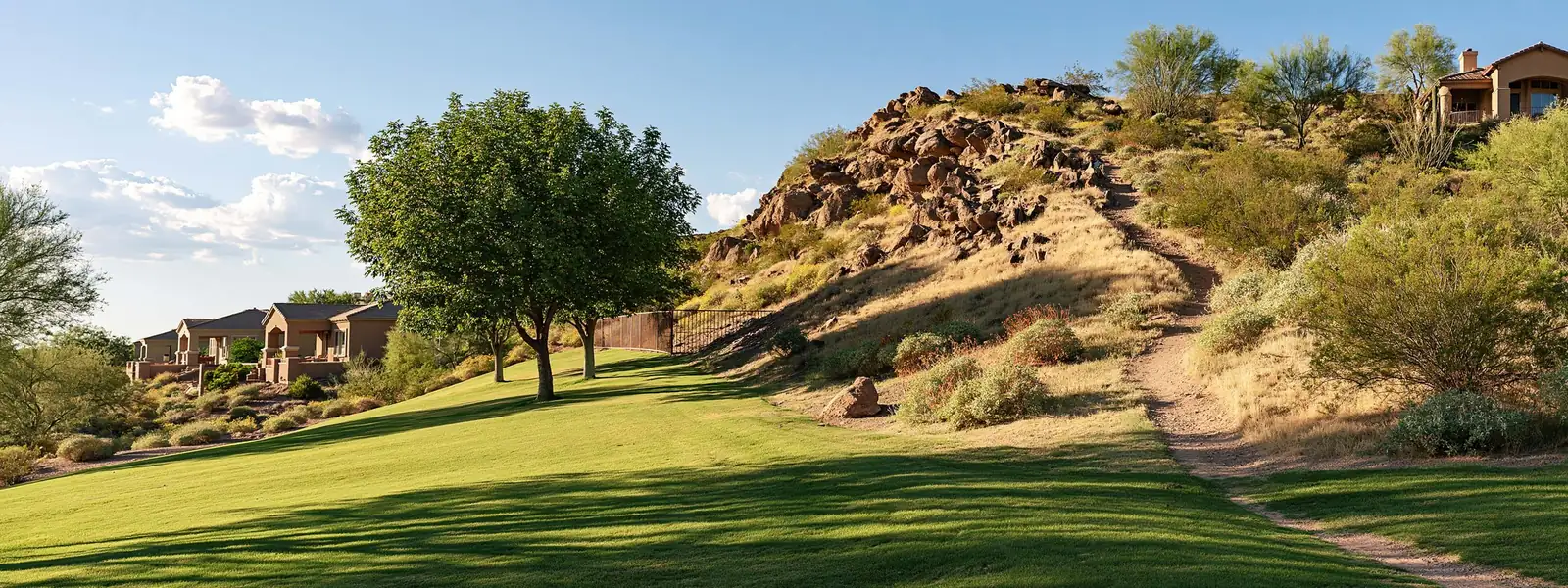
Ahwatukee is a village of Phoenix hemmed in by mountain preserve, and that geography shows up in the fencing. Plenty of lots here back onto a slope or onto open desert rather than onto another back yard, and a boundary in that position does a different job.
It is usually open rather than solid, because the view is the reason the lot costs what it does. That means iron, and it means the fence line is on display from inside the house as well as from the trail side of it. Nothing hides on a lot like that.
Ground is the other difference. A fence crossing a slope has to step down it or rack with it, and neither is a decision to leave to whoever is digging. Where the slope sheds water, monsoon runoff funnels along the low point and arrives at the base of a wall carrying grit and debris. That is where footings get undermined, and it is worth looking at before the summer rather than after.
Gates take the most use and show it first
A gate is the only part of a boundary that moves, so it wears at a completely different rate from the fence it sits in. Side gates on these lots get used every day, and the hardware, not the gate, is almost always what has given up. A leaf that drags or misses the latch is usually a re-hang, and it is the same latch a pool barrier depends on. Detail on gate repair.
What a first visit looks like
Someone walks the whole run with you rather than looking at the one bad spot, because the match question depends on what is on either side of it. On block that means finding where sound block starts and stops. On iron it means checking the bottom few inches where the coating goes first, and the hinges on anything that swings.
Then you get a price in writing, worded so it can be submitted rather than translated. The visit is free, and if the honest answer is that your wall or fence has years left in it, that is the answer you get.