Wrought Iron Fence Installation and Repair in Tempe, AZ

New iron for front yards, courtyards, pool enclosures and driveway gates, and a fresh finish on the iron you already have. The fence that marks your line without taking the view with it. Free estimates, with a firm price in writing.

Call (480) 470-8551 Get Your Free Estimate
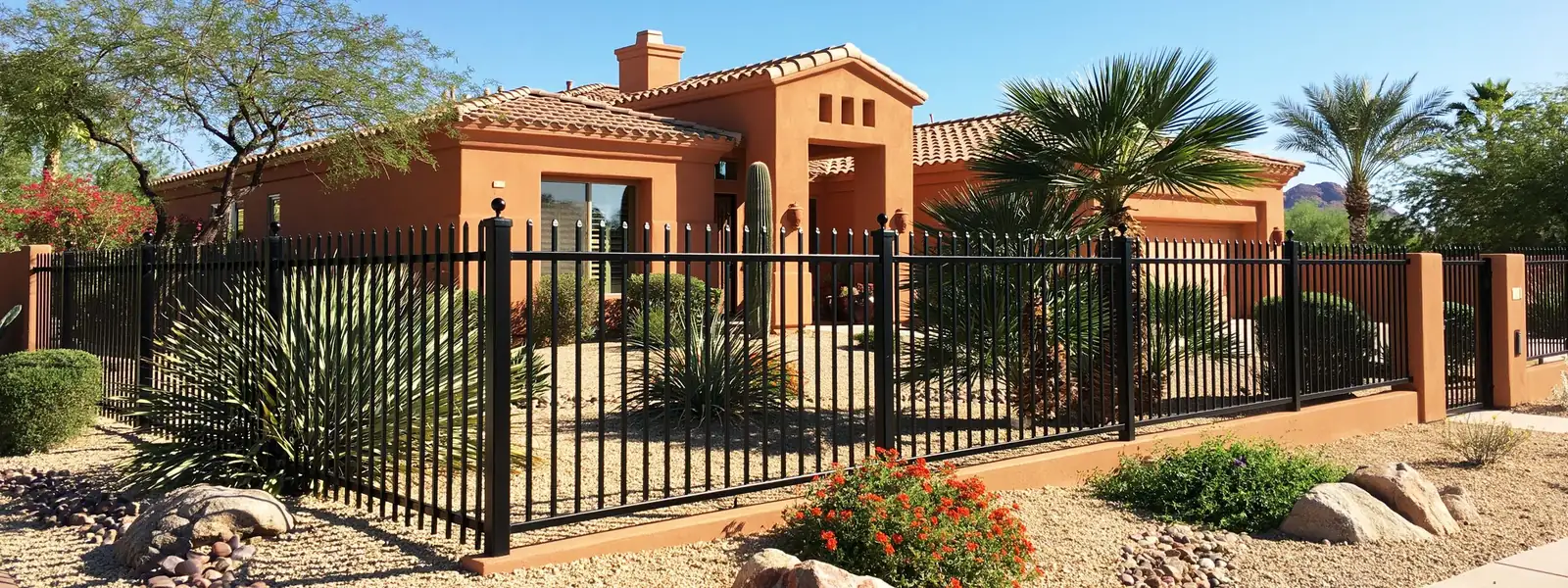
Wrought iron fencing in Tempe, AZ running along the front of a terracotta stucco home, every picket plumb and evenly spaced with the desert yard visible through it

Iron Fencing in Tempe, Made to Be Seen Through

An iron fence marks where your property ends without taking anything away from what you look at. A solid wall closes a yard off. Wood closes it off and then asks to be replaced. Iron draws the line and leaves the outlook where it was.

Tempe Fence Company installs and refinishes iron across Tempe and the East Valley: front yard panels, courtyard openings, pool enclosures, driveway gates, and the back run where a view is worth keeping. A wrought iron fence in Tempe has one weak point, and it is not the metal. It is the finish, and it goes first at the bottom where the sprinklers reach.

That is better news than it sounds. Iron that has started to turn orange low down is usually iron worth keeping. Someone comes out, looks at the fence, and tells you plainly which of the two you have. The visit is free, with no obligation at the end of it.

Why Iron Ends Up on So Many Tempe Yards

Every fence does two jobs at once. It marks a line, and it decides what you can see. Most materials make you pick one. A solid wall gives you privacy and takes the outlook with it, and on a lot where the view was part of the price, that is an expensive trade.

Iron refuses the trade. Open pickets mark the boundary clearly, keep a dog or a child on the right side of it, and leave the ground, the water and the mountain line beyond exactly where they were. Where a back yard opens onto a wash, a green belt or open desert, the fence stops being a barrier and starts being a frame.

Where iron earns its place

Four spots on a Tempe property where iron is usually the right answer:

  • Along a back or side run with something worth looking at, where a solid wall trades away a view you paid for in exchange for privacy you may not need on that side.
  • Around a pool, where seeing the water from the patio is the whole point and the enclosure still has a safety job to do.
  • Across a courtyard or a front entry, where a panel and a gate close the space off without making the house feel shut against the street.
  • At the driveway, where a gate has to be heavy enough to matter, hang square for years, and still let you see who is at the end of it.

Plenty of Tempe yards use two materials rather than one. Block down the sides where the neighbors are, iron along the back or the front where the view is. That is not a compromise. It is each material doing what it is good at.

The finish is what wears, not the metal

Iron here does not age the way people expect. The pickets do not rot, and the sun does little to them. What ages is the coating baked onto the outside of the steel, and it ages from the ground up.

The reason is not complicated. The last stretch of picket before the ground gets wet every morning from irrigation and lawn spray, then bakes dry by the afternoon. Do that a few thousand times and the finish lets go there first, while the top of the same picket still looks close to new.

That changes the decision you are making. A fence that looks finished from the driveway is very often a fence that needs the bottom of its pickets dealt with and nothing else.

Signs Your Iron Is Ready for a Look

Orange showing in the last few inches of the pickets while the tops still look fine
Rust color bleeding down the block or concrete under the fence line
A finish that has bubbled or flaked along the line the sprinklers reach
A gate that drags on the ground, or only latches if you lift it first
A panel that has worked loose from its post, or a post that gives when you push it
A yard open to a view you would rather keep, with nothing marking where it ends

Refinish the Iron You Have, or Start Again?

Refinishing is the cheaper answer, and on most Tempe fences it is the right one as well. Steel is thick, and rust sitting on the outside of a picket is a long way from rust that has gone through it.

The decision has little to do with how bad it looks from the street. Orange staining looks alarming and is usually shallow. What matters is whether the steel still has its thickness, and the only way to know is to get down at the base of the fence and check.

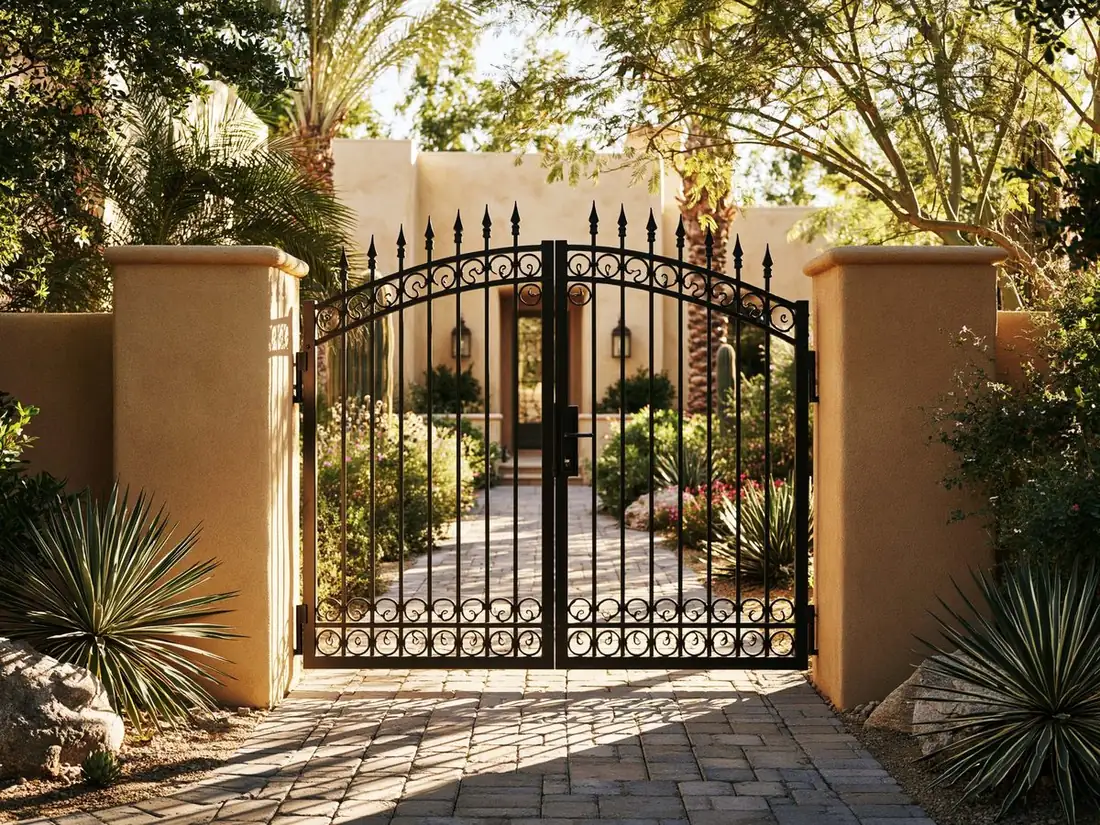
Black wrought iron gate set into a tan block wall at a Tempe, AZ home, hanging square with a smooth satin finish

When a fresh finish is the whole job

Where the metal is sound, this is a finishing job rather than a fencing job. The rust comes back to clean steel, the bare metal is treated and primed so it cannot start again from underneath, and a new coat goes over the top. The run comes back looking like the week it went in.

Color is worth a minute. A refinish is your chance to keep the shade you have or change the whole run at once so it answers to your house.

The other thing that gets sorted is the reason it happened. If a sprinkler head throws water at the fence line every morning, turning it a few degrees costs nothing and buys years. That advice is free whether we do the work or not.

When a stretch is better off replaced

Sometimes the steel really has gone. If the bottom of a picket has opened up, flaked into layers, or gives when you press a screwdriver into it, no coating will bring it back. Covering it hides the problem for a season.

The useful thing about iron is that it comes apart in pieces. A run is panels and posts, so a bad stretch lifts out and a new one goes in without touching the rest of the fence. New panels get matched to the existing pattern and picket spacing as closely as current stock allows, and the whole run is finished in one color, which is what stops a repair reading as a patch from the street.

Gates are their own conversation, because a gate carries weight the fence never does. Hinges, latches and the post holding it up wear out long before the gate itself. Gate repair covers gates that drag, stick or will not latch.

What Moves the Price on Iron Fencing

Iron prices on more than length, which is why a number given over the phone is a guess. These are the things that actually move it, and they are what gets looked at on the visit.

The estimate you get back is a firm price in writing covering exactly what the work includes, so you can hold it up against anyone else's on equal terms.

What the visit looks at

  1. How long the run is, and how many corners and posts it turns
  2. How tall the panels are, and how plain or decorative the pattern is
  3. How many gates there are, how wide they swing, and what hardware they carry
  4. What the ground is like where the posts go, and whether concrete has to be opened
  5. On existing iron, how much is a refinish and how much needs replacing
  6. Whether the fence is enclosing a pool, and whether the height needs a permit

How New Iron Goes In

The posts decide how long it lasts

An iron fence is a line of posts with panels hung between them. Almost everything that goes wrong structurally goes wrong at a post, so that is where the work goes.

Under a lot of Valley yards there is a hard layer that water will not pass through. Dig a post hole into it and the hole holds water like a bucket, which is the one thing steel in the ground does not want. The answer is technique rather than a different material. The hole goes deep enough for the height of fence standing on it, gravel at the bottom gives water somewhere to go, and the concrete is finished above ground with a slope so water runs away from the post.

Then point the irrigation somewhere else. It is the cheapest thing anybody can do for an iron fence, and usually the reason the last one did not last.

Iron and block, working together

Iron and block suit each other here, and a good number of the better looking front yards in Tempe use both. Thicker block columns at intervals with iron panels spanning between them gives you weight where the eye wants it and openness in between.

If block columns are part of the plan, the two trades get planned together rather than in sequence. Panel widths follow the column spacing, and the fixings for the iron go in while the block is being built instead of being drilled in afterward. New block wall construction covers the wall side of it.

Height is worth raising early. Tempe treats front yards differently from back and side yards, and above a certain height a fence needs a permit. Where your project lands gets confirmed before it is quoted, not after. If your community has a standard of its own, bring it to the estimate so it lands in the price rather than turning up halfway through.

Wrought Iron Questions, Answered Plainly

Does a sagging iron gate mean the gate is finished?

Usually not, and more often than people expect. Most gates that have stopped working properly are not broken gates. They are a hinge that has worn, a latch that has drifted out of line, or a post that shifted enough to throw the whole thing off square. Those are ordinary repairs and the gate itself is fine. Where a gate genuinely has gone, it is almost always the bottom rail, the part closest to the ground and the water. Even then, rebuilding that section is often possible. You get told which one you are looking at before anything is booked.

What are the disadvantages of a wrought iron fence?

There are three worth knowing and none of them is a secret. You can see through it, which is the point on a view side and the wrong choice where you want privacy. It does not stop wind or traffic noise the way a solid wall does. And the finish is not quite nothing. Keep the sprinklers off it, rinse it when you rinse the yard, and touch up a chip before it has a chance to rust. A powder-coated run that gets that much lasts ten to twenty years here before it wants refinishing, and where it goes first is the bottom few inches, where the irrigation hits. In exchange you get a fence that does not rot, does not go brittle in the sun, comes apart section by section for repair, and can be brought back to looking new.

Can rusted iron be refinished, or does it have to be replaced?

Most of it can be refinished. Rust sitting on the outside of a picket is a coating problem, and coating problems are fixable: back to clean steel, treat and prime the bare metal so it cannot start again from underneath, then a new finish across the whole run so it matches. What cannot be saved is steel that has lost its thickness. If the bottom of a picket has flaked into layers or gives under a screwdriver, that stretch gets replaced rather than painted over. Most fences turn out to be a mix.

What is the average cost of a wrought iron fence in Tempe?

There is no average that would help you, and any number quoted before somebody has seen the property is a guess wearing a suit. What decides it is the length of the run, the height of the panels, how plain or decorative the pattern is, how many gates there are and how wide they swing, and what the ground is like where the posts go in. On iron you already own, it also depends on how much is a refinish and how much needs replacing. You get a firm price in writing.

What is a cheaper alternative to a wrought iron fence?

Chain link is the least expensive way to mark a boundary and still see through it, and it is a sensible choice on a side yard, a rental, or anywhere the look is not the point. Wood and vinyl both cost less than iron and give you privacy instead of a view, though both answer to the sun here in a way iron does not. Choose by the job rather than the price list. If you want a fence because you like what is on the other side of it, iron is the material that keeps it.

Can iron be used as a pool fence?

Yes, and around here it is the usual choice, because it lets you see the water from the patio and the kitchen window instead of staring at a wall. Arizona sets requirements for a pool barrier covering the height, the spacing between the pickets and the way the gate behaves. The gate has to close and latch on its own every time, and swing away from the pool. Local rules can be stricter and the inspector has the final say, so treat this as general information rather than a code determination. Pool fencing goes through it properly.

See all fence and block wall questions →

Related Work in Tempe

Pool Fencing

The enclosure that lets you watch the water, with a gate that latches on its own.

See Pool Fencing →

Gate Repair

Iron gates that drag, stick or will not latch. Usually a hinge or a post, not the gate.
See Gate Repair →

Automatic Gate Repair

Driveway gates, openers and keypads. Worth planning before the iron goes in.

See Automatic Gate Repair →

Block Wall Construction

Block columns with iron panels spanning between them, planned together from the start.

See Block Wall Construction →

Iron in Scottsdale

View fencing and driveway gates on bigger lots, where the fence is part of the view.

Fencing in Scottsdale →

Iron in Ahwatukee

Panels, colors and heights matched to the standard your community expects.

Fencing in Ahwatukee →
Homeowner walking through a decorative wrought iron gate under a stucco arch at a Tempe, AZ home, the gate swinging free on its hinges

Get Your Free Estimate

Tell us what you are looking at. New iron across the back, a courtyard panel, a driveway gate, or a run that has started to turn orange at the bottom. Someone comes out, checks what the steel has left in it, and gives you a firm price in writing. No cost, and no obligation to book the work. Call (480) 470-8551 or fill out the form.

Rust is a finish problem, not a fence problem.

Call (480) 470-8551